Why write a book about a four-decade-old plane crash?
For starters, no such book has been written since American Airlines Flight 191 plunged into the ground in a raging fireball just after takeoff from Chicago’s O’Hare Airport on May 25, 1979. For a culture obsessed with “top-whatever” rankings and endless lists, that’s more than a little surprising; Flight 191’s record-shattering death toll – 271 souls on board and two ground bystanders – has never been surpassed in an aviation accident on U.S. soil since. After the 9/11 attacks, list-makers scrambled to make new distinctions, creating the ersatz categories of “aviation accident” as opposed to “aviation disaster.” In any case, the very nature of 9/11 disqualifies it from this list; those hijackers were trying to kill hordes of people, and lo and behold, they did. The story of Flight 191 is more complicated, and in a subtle and intangible way, more frightening.
Which leads me to my second reason: this is a story of hidden risk suddenly laid bare; of the fragility of human life in the hands of the makers, keepers, and operators of technology upon which thousands of us rely daily. It’s a story of fateful chain reactions, of small, unnoticed mistakes that compound into a cataclysmic cascade of failures and devastation. The American Airlines mechanics who took maintenance shortcuts while servicing the doomed DC-10 in March 1979 had no clue that they had inflicted insidious damage to the plane’s Number One engine pylon, and that that damage would lead to unfathomable suffering and grief for so many hundreds of people. Nor did the decision-makers at the airline suspect that they would be running for cover, shredding documents and fudging details under the suspicious eyes of accident investigators and aviation regulators; or that they would soon be locked in a vicious legal battle with the plane’s beleaguered manufacturer over the costs of multimillion-dollar lawsuits, putting the entire future of an industry in the balance.
It’s all there: fallibility, tragedy, corruption, scandal – “the aviation equivalent of Silkwood,” in the words of investigative journalist Peter Greenberg. The makings of an epic true-life saga that yanks an embarrassing skeleton from a major corporation’s closet, all while echoing the current debacle over Boeing’s controversial 737-MAX series, reminding the reader that there is nothing new under the sun, and that for every safety improvement that comes along – many of which were a direct result of Flight 191 – the hidden risk, the imperceptible brush with death, remains. The Sword of Damocles forever hangs over our heads whenever we board an airliner, placing our faith in thousands of unseen experts and laborers.
But perhaps my third and final reason is my most compelling. To paraphrase W.B. Yeats, I find myself driven by a lonely impulse of horror.
When National Transportation Safety Board (NTSB) investigators listened to Flight 191’s Cockpit Voice Recorder (CVR) the day after the crash, they had a perfect, crystal-clear record of the flight crew’s words right up until the moment the Number One engine ripped away from the wing as the plane left the runway. First Officer James Dillard, who was performing the takeoff, muttered, “Damn!”
Then the tape went dead.
Ironically, this aided the investigation, in that it showed exactly when power to numerous cockpit instruments was lost – a crucial failure that would contribute to the eventual crash – and which ones were, indeed, lost. But for observers like me, it casts an extra pall of mystery, dread, and horror over the whole event.
We do not know what was said in the cockpit in those thirty-one seconds the plane was airborne. We do not know how Dillard, Captain Walter Lux, and Flight Engineer Alfred Udovich reacted to the onset of the fateful stall that would cause their giant craft to flip over in the sky. We know what they did – struggle with the controls all the way down, tragic heroes to the end – but we don’t know what they said. We don’t know the confusion, the urgency, the desperation, and perhaps the final resignation in their voices. And we’ll never know.
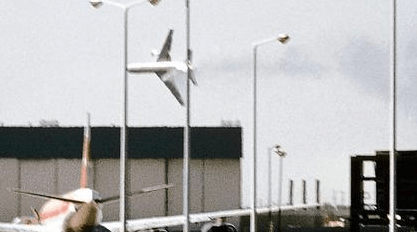
Nor do we have any record of what was seen, heard, felt, and screamed in the packed passenger cabins. Even had this occurred in the era of AirFones and, later, cell phones, there was simply no time. All we have is a single, stunning photograph taken by private pilot Michael Laughlin from O’Hare’s terminal. In it, the DC-10 is hurtling toward the ground, hydraulic fluid streaming from its damaged left wing with an engine missing, partially inverted, its right wing stabbing toward the heavens.
These were the final seconds of the lives of 271 people cocooned and trapped within that aluminum shell, and all we have are our merciless imaginations.
Every other aspect of this drama revolves around those fateful thirty-one seconds, and the moment when pleasant suburban Midwestern America, on a clear, sunny holiday weekend, suddenly became Hell on Earth. This is the story of that horrifying half-minute, over in a relative blink of an eye, which was nonetheless months in the making and many years in its reverberating consequences. In that sense, this is a story of the 1970s, of today, and of everything in between.
 Vlad Smitrovich